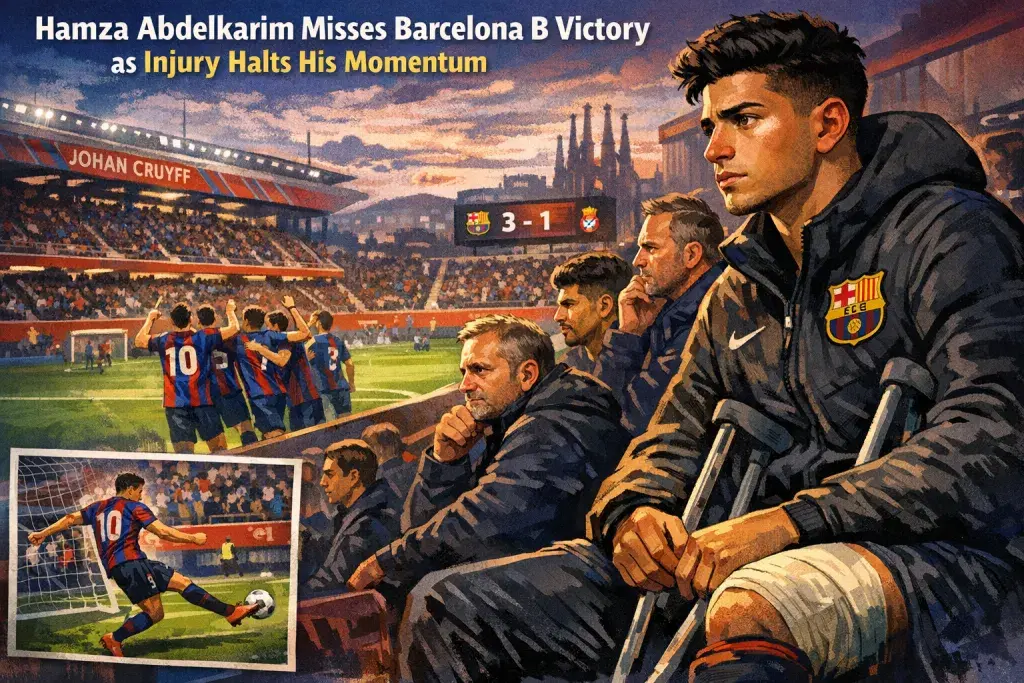
Egyptian forward Hamza Abdelkarim was absent from Barcelona B's 3–1 victory over Espanyol at the Johan Cruyff Arena, sidelined by an injury he sustained in late March. The setback arrives at a particularly sensitive moment in the 19-year-old's development, cutting short what had been a carefully managed introduction to competitive football at reserve level. He watched proceedings from the stands alongside several senior figures — including head coach Hans Flick, Ronald Araújo and Lamine Yamal — underlining both the occasion's significance and his own frustrated proximity to it.
A Debut That Set Expectations High
Abdelkarim's introduction to Barcelona B's competitive calendar began with considerable promise. In a Segunda División B fixture against Huesca, he not only featured from the outset but also won a penalty and stepped up to convert it himself — a composed, assertive performance for a young forward making his official reserve-team debut. The fact that the side ultimately lost that day did little to diminish the individual impression he left. Scouts, coaching staff, and observers tracking the club's youth pipeline noted the confidence and technical maturity he brought to a high-pressure moment.
Debut performances carry an outsized psychological weight in a young professional's early career. They establish baseline expectations — among coaches who must decide on future deployment, among peers adjusting to a new presence, and within the player himself. When that debut produces something tangible and visible, as Abdelkarim's did, the standard it sets becomes both a motivating reference point and a source of pressure in the outings that follow.
The Difficult Second Act
Since that opening fixture, Abdelkarim has featured in several subsequent appearances, including a start in the Copa del Rey youth semi-final in Lugo. His most recent involvement came as a substitute in the 21 March defeat to Damm — approximately 30 minutes of playing time before he picked up the injury that has now ruled him out. None of those appearances, by available account, reproduced the clarity and impact of his debut.
This pattern — a striking entrance followed by more uneven contributions — is neither unusual nor necessarily alarming at this stage of development. Young forwards at elite academies are subject to intense tactical demands, physical conditioning requirements, and the psychological complexity of performing under institutional scrutiny. The learning curve is rarely linear. What matters in these circumstances is continuity of opportunity, which the injury has now temporarily removed.
What Physical Setbacks Mean at This Stage of a Career
For a young professional in the early phase of establishing himself at a prestigious club, an injury is rarely just a physical event. It disrupts rhythm at precisely the moment when consistent exposure is most valuable. Muscle memory, positional familiarity, and tactical cohesion with established squad members all require sustained repetition to consolidate — none of which can occur from the stands.
The nature and duration of Abdelkarim's current injury has not been specified in detail. What is known is that it followed his 30-minute appearance on 21 March, suggesting the possibility of a soft-tissue issue, though no official medical characterisation has been confirmed. Recovery timelines for such injuries vary considerably depending on severity, the quality of rehabilitation support available, and the individual's physiological profile.
Barcelona's academy infrastructure — known as La Masia — is among the most developed in world football, offering access to medical, nutritional, and psychological support of a high standard. That context matters. A player recovering within such an environment is more likely to return in a managed, structured way than one navigating rehabilitation with fewer institutional resources around him.
The Broader Picture for Egyptian Talent in European Football
Abdelkarim's presence at Barcelona B is itself part of a broader, still-developing story about Egyptian and North African footballing talent finding footholds at top European clubs. The pathway from Cairo or Alexandria to a Johan Cruyff Arena bench involves a convergence of scouting reach, family decisions, linguistic adaptation, and the willingness of clubs to invest in players whose development arc extends several years into the future.
His injury, in this sense, is a temporary interruption — not a conclusion. The more relevant question is what kind of player returns from it, and whether the opportunity to build on his debut's promise remains available when he is fit again. For now, Abdelkarim watches. The work of returning is what comes next.