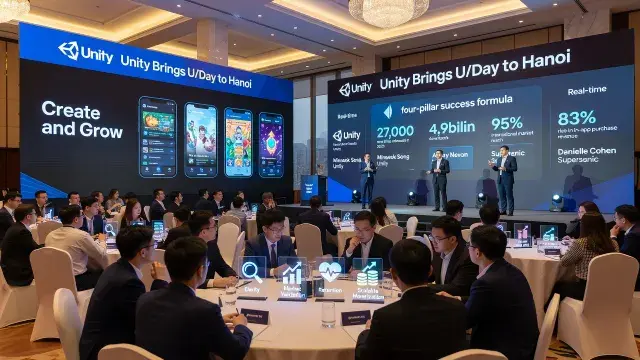
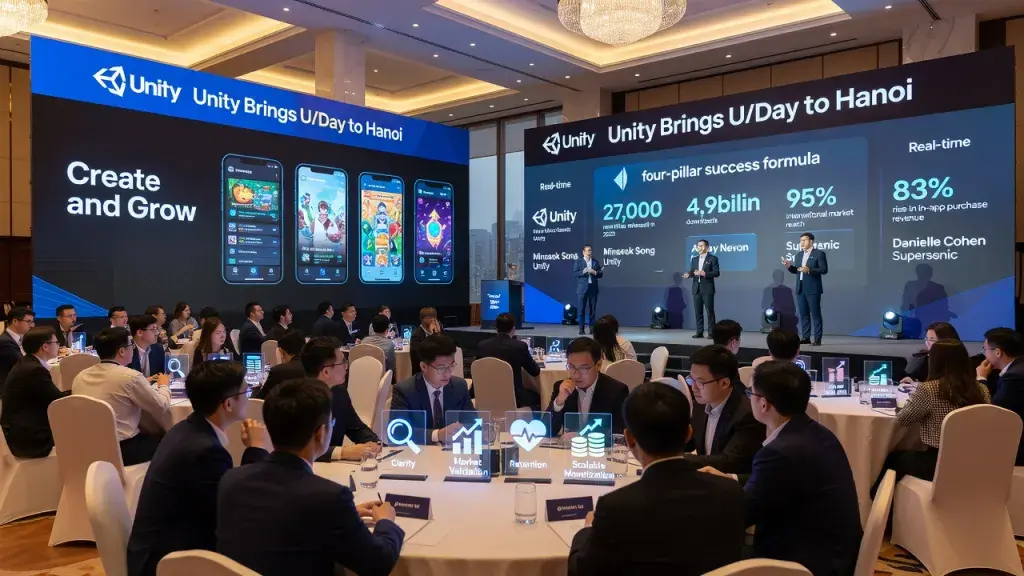
Unity held its first official developer-focused event in Vietnam on June 17, gathering studios, creators, and industry figures in Hanoi for U/Day Hanoi 2026. The gathering centred on two pillars of Unity's platform offering - Create and Grow - and served as a formal acknowledgement of Vietnam's rapidly expanding role in global mobile gaming. The timing is no coincidence: the numbers behind Vietnam's game development sector have become too significant to treat as a regional footnote.
Vietnam's domestic studios released more than 27,000 new titles in 2025 alone, generating 4.9 billion downloads and pushing the country to second place globally in mobile game downloads. That scale of output puts Vietnam in genuinely elite company, and yet the more telling story is the shift in how studios are approaching growth. Rather than chasing raw download volume, an increasing number of developers are pivoting toward sustainable monetisation models. According to Gamota's Vietnam Mobile Gaming Year-in-Review 2025 report, in-app purchase revenue climbed roughly 83 percent year-on-year, while 73 percent of Vietnamese studios have moved away from pure ad-based models toward IAP or hybrid IAP-and-advertising strategies. The industry's maturation is also mirroring a broader diversification in entertainment spending - much like how padel betting online has carved out a distinct audience within a wider sports wagering ecosystem, Vietnam's game studios are learning to segment and optimise rather than simply scale.
Speaking at the event, Minseok Song, Unity's Head of Entertainment for Korea and Southeast Asia, framed the moment with clear conviction. "Vietnam's market presents an incredibly impressive picture of development," he said. "I have complete confidence in the successes Vietnamese developers will achieve in the future. You have the talent, the ambition, and the vision to help shape the games industry." Song's remarks were backed by data pointing to Vietnam as one of the country's most successful digital content export sectors - a status that reflects the depth of the local developer community rather than a single breakout title or studio.
95% of Downloads Come from Outside Vietnam - and That Changes Everything
Ashley Nevon, Unity's Vice President of Global Partnerships, offered perhaps the most striking data point of the day. "Through data analysis, we've found that approximately 95 percent of downloads of games created by Vietnamese developers come from international markets," she said. That figure reframes the entire conversation about what Vietnamese game development actually is: not a domestic content industry serving local players, but a globally competitive export engine whose products are being chosen by users on every continent.
Nevon noted that years of engagement with the Vietnamese market have reinforced her view of the local developer community as one with both high-quality talent and considerable room for further growth. The global context amplifies the stakes. The worldwide games market is currently estimated at around $210 billion - a figure that exceeds the combined revenues of streaming video, streaming music, and global cinema box offices. Mobile gaming alone accounts for roughly 60 percent of the approximately $130 billion that users spend on apps annually. For Vietnamese studios with international ambitions, the choice of development platform is therefore not merely a technical decision but a strategic one with direct implications for reach, performance, and commercial viability.
Supersonic's Four-Pillar Formula for Sustainable Game Success
Danielle Cohen, Senior Director of Strategy and Revenue at Unity's Supersonic studio, pushed back against the myth of overnight success in game development. Citing titles in Supersonic's catalogue that have maintained top chart positions for more than five years since launch, she argued that longevity is the product of deliberate design, not fortune. "Many people think successful games happen by luck," she said. "But the reality is that successful titles are built from a clear formula."
Cohen outlined that formula across four components. First, the game must be immediately legible to players - clarity of concept and mechanic from the moment of first contact. Second, studios must validate market fit early, before significant resources are committed to a product that may not resonate with its intended audience. Third, retention must be a design principle, not an afterthought - the experience should be built from the ground up around keeping players engaged over time. Fourth, monetisation strategies must be scalable and layered, combining IAP revenue streams with advertising in a way that can grow as the user base expands. The framework is not proprietary to Supersonic, but hearing it articulated with commercial evidence behind it carries weight for developers looking for actionable direction rather than abstract advice.
Competition Announced With Prize Pool of Up to $200,000
Unity also used the Hanoi event to announce a forthcoming competition aimed specifically at developers within Vietnam's gaming ecosystem. Scheduled for next month, the contest will offer prizes ranging from $30,000 to $200,000 - a meaningful incentive that signals Unity's intent to invest in the local community rather than simply address it as an audience. For smaller independent studios, the lower end of that prize range alone could represent a meaningful injection of capital at a critical development stage.
The broader platform context underlines why Unity's engagement with Vietnam matters beyond the event itself. More than 70 percent of the top 1,000 mobile games in 2025 were built on Unity, and by December 2025, applications developed with Unity were estimated to reach more than three billion active devices monthly worldwide. For Vietnamese developers targeting international markets, alignment with that infrastructure is both practically useful and commercially logical. U/Day Hanoi 2026 marks the beginning of what Unity clearly intends to be a sustained presence in one of Southeast Asia's most dynamic game development markets.